phoenix Zoo TRAIL CARDS
Location:
Africa Trail - Predator Passage
African Lion
Zuri (F) 10/25/2017
Kamara (F) 10/25/2017
PiliPili (M) 3/15/2022
His name means "pepper" in swahili, pronounced pee-lee pee-lee
Identifying Features:
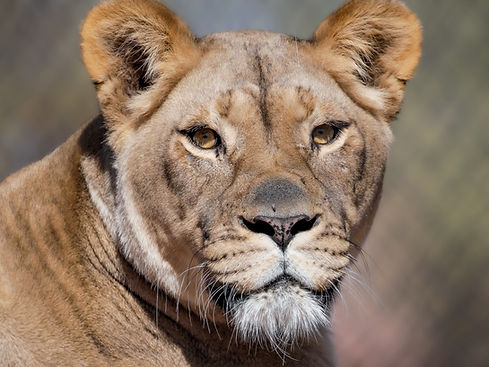
Zuri has a light crescent shaped patch on her forehead and larger freckles on her nose. She has a smaller tuft of black on her tail. Weight - 359 lbs (7/24/26)
Kamara is a bit bigger than Zuri with a rounder head. She has a dark spot on her forehead and smaller nose freckles. She has a larger tuft of black on her tail. Weight - 353 lbs (7/24/26)
Pilipili is our male, he has a few wounds from transport. Weight - 548 lbs (7/6/26)
Click on "Read More" or scroll down for pictures.
History:
Pilipili was born at Lincoln Park Zoo in Chicago. He arrived in Phoenix late 2025.
Our male, Boboo (8/16/2015) arrived on 3/10/2019 from Columbus Zoo
He passed away on 6/28/24, after an examination revealed he had an agressive cancer on his kidneys and spleen.
Zuri & Kamara arrived from the Pueblo Zoo on 10/10/23.
Zuri gave birth on 6/3/24 to two cubs, Azizi & Jasiri
Azizi (means "precious" in Arabic and Swahili) (M) 6/3/2024
Jasiri (means "brave" in Swahili) (M) 6/3/2024
The cubs were transferred to Zoo Miami in November of 2025
In December of 2025, a new male arrived- PiliPili!
More Information:
IUCN: Vulnerable
Lives in prides - only cat to live in multi-sex social groups
Prides can have up to 40 individuals of related females, sub-adult cubs, plus one or more resident males. Availability of prey plays a significant role in the size of a pride.
Females usually stay in their mother's pride for life, unless food scarcity forces them out.
Young males are drive out when they grow large enough to compete with the dominant males. They create coalitions, usually with brothers or cousins, and search for a pride to take over.
Males entering a new pride will kill all the cubs that cannot run from them.
Adult males within a pride hold tenure for an average of two years, often leaving due to evicition by another coalition of males.
Females hunt cooperatively.
Females raise the cubs and are the primary hunters, although amles will sometimes join females during a hunt.
Both males and females mark their territories by scent marking with urine and roaring, which can be heard up to five miles away.
Sleep 18-21 hours a day
Strong competition with spotted hyenas
Diet: Medium to large-sized ungulates
Will take almost any animal, from rodents to rhinos.
Females live loinger than males.
Male lions rarely live past 10 in the wild an can live into their late teens in managed care.
Females normally live up to 15 to 16 years in the wild. In managed care they can live into their early 20's.
Lions stand between 3.5 and 4 feet tall at the shoulder.
Males grow to lengths of 10 feet and weigh from 330 to 550 pounds.
Females grow to lengths of 9 feet and weigh between 265 and 395 pounds.
Lion Diets at Phx Zoo:
Carnivore Diet (looks like ground beef) 5 lbs. each, 4 days a week
2-3 pieces of chunk meat (.66 lbs), 6 days a week
Whole chicken 1 day a week
Bone day - Tuesdays
CONSERVATION: The Phoenix Zoo supports Lion Landscapes' work to conserve lions and reduce human-lion conflict in Tanzania by supporting the establishment and continuation of wildlife clubs in schools, as well as a teacher training program for these clubs. Students in these wildlife clubs learn about human-wildlife conflict as well as the national parks and wildlife near their communities. They also participate in conservation activities and field trips that allow them to view wildlife in a non-threatening environment.
LEARN MORE HERE: https://www.lionlandscapes.org/
Zuri - small white crescent on forehead


Kamara
